Monday to Friday: 09:00am – 07:00pm
Sunday: Close
Email:stemhighpreschool@gmail.com
Phone:+91 8050125666
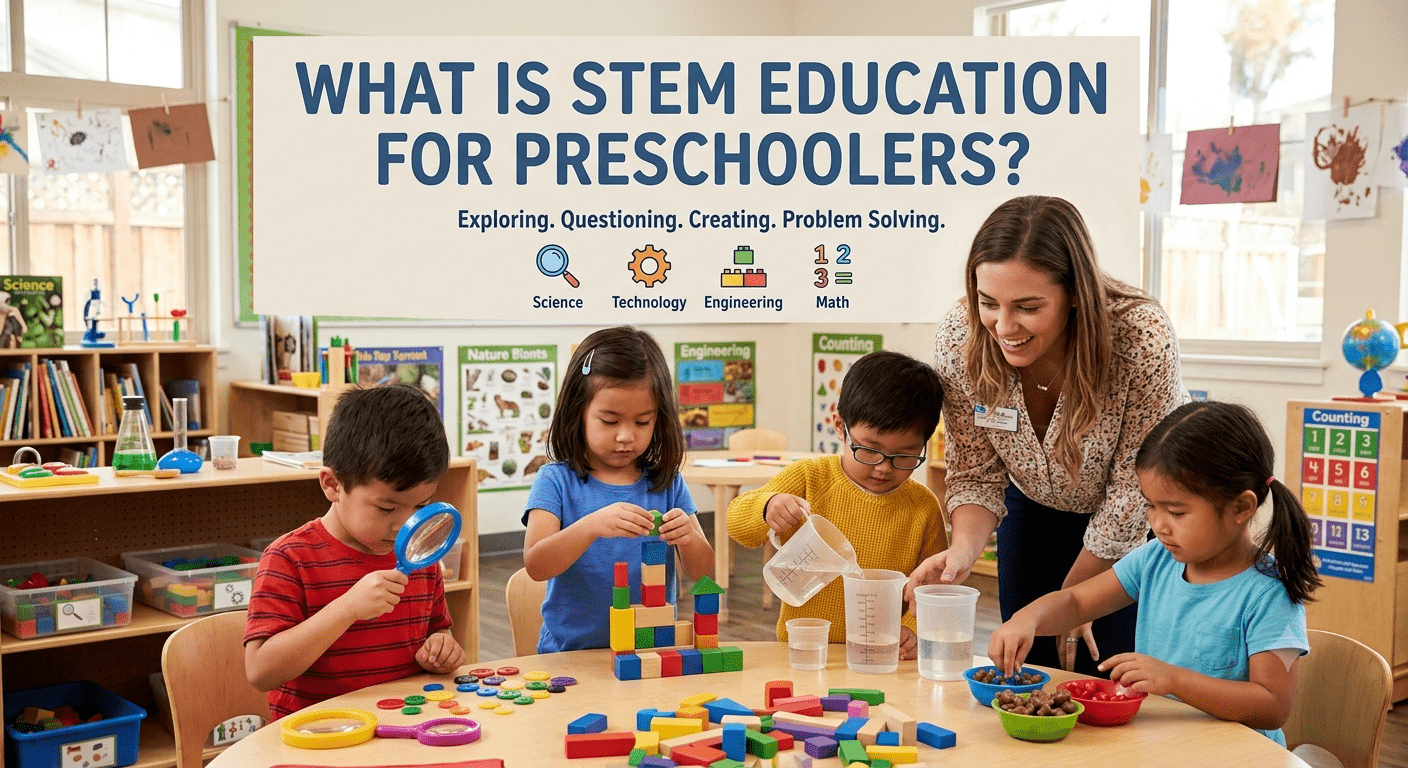
When parents hear the term STEM education, they may imagine older children learning advanced science, coding, engineering or mathematics. But STEM learning can begin much earlier.
In preschool, STEM education is not about teaching complicated formulas or expecting young children to understand advanced technology. Instead, it is about helping children explore, ask questions, experiment, build, count, observe and solve simple problems through hands-on experiences.
A child wondering why an object floats, building a tower with blocks, sorting objects by size, observing how plants grow or figuring out how to make a bridge stronger is already engaging with the basic ideas behind STEM.
For preschoolers, STEM education is primarily about developing a curious and confident approach to learning.
At STEM High Preschool, STEM-based learning can be introduced through age-appropriate activities that encourage children to explore the world around them while developing early skills in science, technology, engineering and mathematics.
STEM stands for:
These four areas are often connected rather than taught completely separately.
For example, imagine preschool children building a bridge using blocks.
They may:
The activity may look like simple play, but children are practicing several important STEM concepts at the same time.
STEM education for preschoolers is a hands-on approach to early learning that encourages children to explore science, technology, engineering and mathematics through play, observation, experimentation, building and problem-solving.
The goal is not to turn preschoolers into scientists or engineers.
Instead, early STEM learning helps children develop skills such as:
Preschool STEM education should be age-appropriate, playful and exploratory.
Children should be encouraged to ask questions and investigate answers rather than simply memorize information.
The preschool years are an important period for developing curiosity and foundational thinking skills.
Young children naturally want to understand how things work. They touch, compare, observe, ask questions and experiment with their surroundings.
A good STEM learning environment uses this natural curiosity as an opportunity for learning.
Children are naturally curious.
They may ask:
Instead of simply giving children the answer, STEM activities encourage them to explore.
This helps develop a habit of asking questions and looking for explanations.
Problem-solving is one of the most valuable skills children can develop early.
Consider a simple activity:
“Can you build a bridge that can hold five toy cars?”
There may not be one correct solution.
A child might build a bridge, test it, watch it collapse, change the design and try again.
Through this process, the child learns that mistakes can be part of learning.
STEM activities encourage children to compare, predict, observe and make simple conclusions.
For example:
“Which object do you think will roll faster?”
Children can make a prediction, test the objects and compare what happened.
This introduces an early form of scientific thinking.
STEM is not only about finding the correct answer.
Many STEM activities allow children to find different ways to solve a problem.
A child building a structure may choose different materials, shapes and designs.
This combines logical thinking with creativity.
Sometimes a child’s first attempt does not work.
A tower may fall.
A bridge may break.
A paper airplane may not fly as expected.
Instead of stopping, children can be encouraged to ask:
“What could we change?”
This develops persistence and encourages children to try again.
Many preschool STEM activities work well in small groups.
Children can build together, discuss ideas, share materials and compare results.
This gives STEM learning a social dimension while helping children practice communication and teamwork.
STEM education for a preschooler should look very different from STEM education for a teenager.
A preschool child does not need advanced equations, programming languages or complicated science concepts.
Instead, STEM can be introduced through:
The emphasis should be on doing, exploring and thinking.
STEM learning does not always require expensive equipment.
Many simple activities can introduce STEM concepts.
Give children blocks and ask them to build the tallest stable tower they can.
Ask questions such as:
Children are exploring basic engineering concepts.
Provide safe household objects and a container of water.
Before placing each object in the water, ask:
“Do you think it will sink or float?”
Children can make predictions and then test them.
This introduces observation and early scientific thinking.
Give children objects of different sizes, shapes or colors.
Ask them to sort the objects into groups.
Then change the question:
“Can you sort them another way?”
This introduces classification and mathematical thinking.
Using blocks, cardboard or other safe materials, children can build a bridge for toy vehicles.
They can test:
This is a simple introduction to engineering.
Children can plant a seed and observe its growth over time.
They can discuss:
Teachers can encourage children to record observations through drawings or simple measurements.
Ask children to find circles, squares, rectangles and triangles around the classroom or school.
This connects mathematics to the real world.
Children can compare objects using simple questions:
These everyday comparisons introduce early mathematical thinking.
STEM and play-based learning work naturally together.
Young children learn effectively when they can interact with materials and explore ideas.
For example, building with blocks can simultaneously support:
The activity does not need to feel like a traditional lesson.
The child can simply be given a challenge and encouraged to explore.
This is one reason play-based STEM learning can be particularly appropriate for preschool children.
A well-designed STEM learning environment can support several foundational skills.
| Skill | How STEM Activities Support It |
|---|---|
| Curiosity | Encourages children to ask questions |
| Problem-solving | Gives children challenges to solve |
| Critical thinking | Encourages prediction and comparison |
| Creativity | Allows multiple solutions |
| Mathematics | Introduces counting, shapes and measurement |
| Communication | Encourages children to explain ideas |
| Collaboration | Supports group projects |
| Persistence | Encourages children to try again |
| Observation | Helps children notice changes and patterns |
| Confidence | Allows children to test their own ideas |
These skills are useful not only for STEM subjects but across a child’s overall learning journey.
No.
This is an important distinction for parents.
STEM education does not have to mean screen-based learning.
In preschool, STEM can involve hands-on activities such as:
Technology can be included when it adds educational value, but it does not need to replace hands-on experiences.
A balanced preschool STEM approach can combine real-world exploration, physical materials, teacher guidance and age-appropriate technology.
Teachers play an important role in turning everyday activities into learning opportunities.
Instead of immediately providing answers, teachers can ask open-ended questions.
For example:
Instead of saying:
“The tower fell because it was too tall.”
A teacher could ask:
“Why do you think the tower fell?”
Then:
“What could we change to make it stronger?”
This encourages children to think rather than simply receive information.
Useful STEM questions include:
These questions help develop reasoning and communication skills.
If you are considering a preschool with STEM learning, look beyond the word “STEM” in the curriculum description.
Parents can ask:
Children should have opportunities to build, explore, experiment and manipulate materials.
A strong learning environment should value curiosity.
Preschool STEM should be designed around the developmental stage of young children.
Science, mathematics, language, art and social learning can work together.
Experimentation requires children to test ideas and learn from what happens.
Technology can support learning, but young children also need physical exploration and social interaction.
Teacher guidance can make simple activities much more meaningful.
At STEM High Preschool in Ramamurthy Nagar, Bangalore, STEM learning can be connected with hands-on exploration, play and age-appropriate activities.
The objective of introducing STEM concepts during the preschool years is not to make children memorize scientific information. It is to encourage them to become curious learners who observe, question, experiment and solve problems.
Activities involving science, building, mathematics, exploration and creative thinking can help children understand concepts through experience.
For parents looking for a STEM-focused preschool in Ramamurthy Nagar, it is useful to visit the school, understand the curriculum and observe how children are encouraged to learn through activities.
Parents do not need expensive STEM kits to support early STEM learning.
Try simple activities such as:
Ask children to count ingredients, compare sizes or observe changes in food.
Look for different leaves, shapes, insects, rocks or patterns.
Ask children to build bridges, towers or houses.
Ask which objects float and which sink.
Compare quantities, sizes and shapes.
Let children observe seeds, roots, leaves and growth.
The key is to turn everyday experiences into opportunities for questions and exploration.
STEM education in preschool introduces basic concepts related to science, technology, engineering and mathematics through age-appropriate activities such as building, counting, observing, experimenting and problem-solving.
Yes. STEM activities can be adapted for young children using simple activities such as sorting, building, observing nature, exploring water and experimenting with shapes and materials.
Examples include building block towers, sink-or-float experiments, sorting objects, measuring, shape hunts, simple science experiments, gardening and building bridges.
No. Preschool STEM can be largely hands-on. Blocks, water, sand, puzzles, natural materials and simple experiments can all support STEM learning.
STEM learning can support curiosity, problem-solving, critical thinking, creativity, early mathematical thinking, communication, collaboration and persistence.
Parents can introduce STEM through everyday activities such as cooking, gardening, building with blocks, exploring nature, sorting objects and conducting simple experiments.
STEM education for preschoolers is about much more than science and technology.
It is about teaching children to be curious, explore their surroundings, ask questions, test ideas and look for solutions.
When a child builds a tower, investigates why it falls, changes the design and tries again, they are learning an important lesson: problems can be explored and solved.
That mindset can become a valuable foundation for future learning.
For parents exploring preschool options in Bangalore, consider looking for a learning environment where STEM is not simply a subject on the timetable but is integrated into play, exploration, creativity and everyday learning.
If you are looking for a STEM-focused preschool in Ramamurthy Nagar, Bangalore, learn more about the programs and learning approach at STEM High Preschool and schedule a visit to understand how STEM concepts are introduced to young learners.
Related STEM High Preschool resources:
Need help? Our team is just a message away








Comments are closed