Monday to Friday: 09:00am – 07:00pm
Sunday: Close
Email:stemhighpreschool@gmail.com
Phone:+91 8050125666
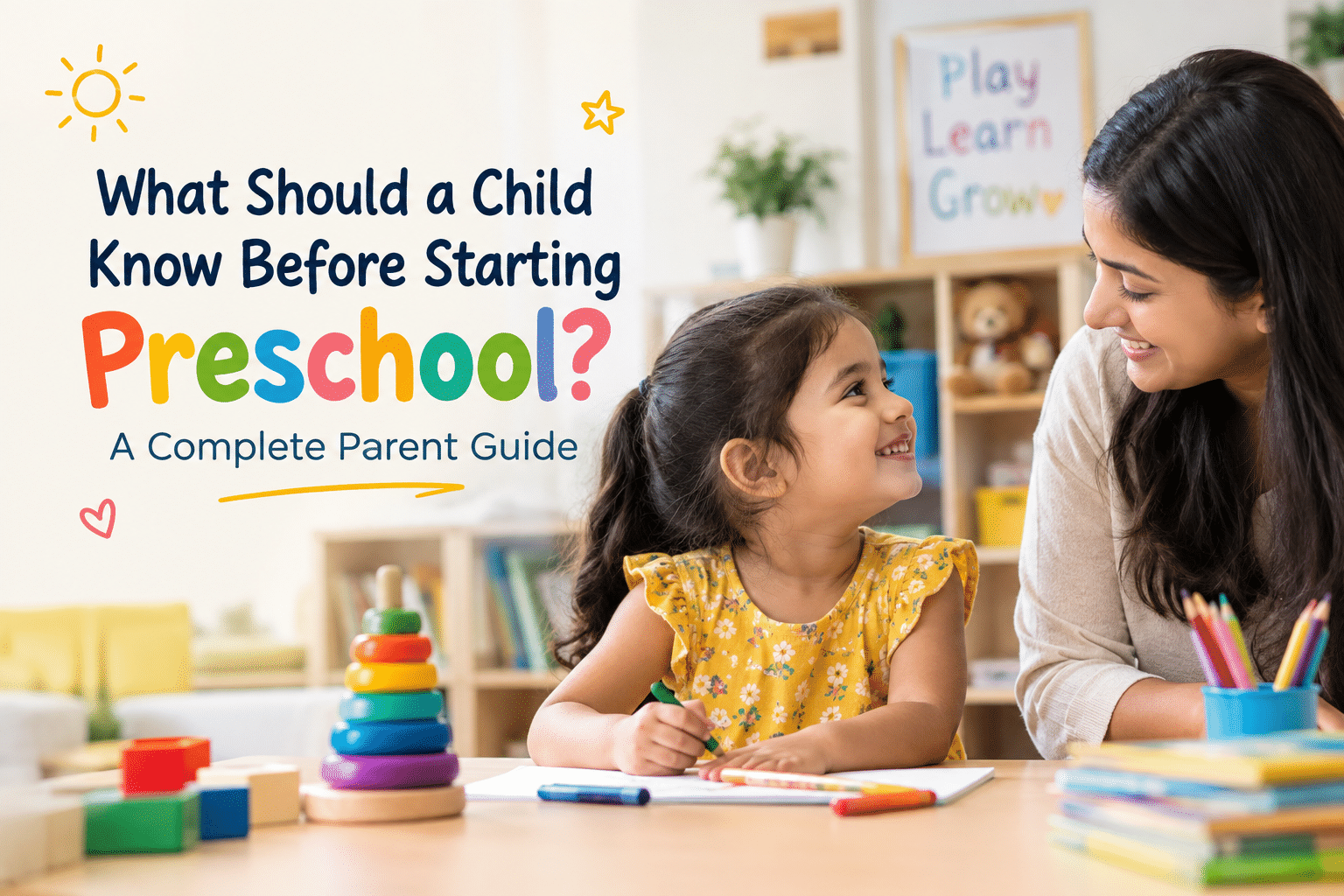
Starting preschool is an exciting milestone in a child’s life. For many parents, it also brings an important question:
What should a child know before starting preschool?
Parents often worry that their child needs to know the alphabet, numbers, colours, or even basic reading and writing before joining preschool. In reality, preschool readiness is about much more than academic knowledge.
A child does not need to know everything before starting preschool. Instead, developing basic communication, social, self-help, emotional, motor, and early learning skills can help them adjust to a classroom environment more comfortably.
Every child develops at a different pace, so this guide should be used as a helpful reference rather than a strict checklist.
Preschool readiness means having some of the basic skills that help a child participate in everyday classroom activities.
These skills can include:
The goal is not to make a child academically advanced before preschool. It is to help them feel confident, curious, comfortable, and ready to participate.
One of the most important skills for a child starting preschool is the ability to communicate basic needs.
A child should gradually become comfortable expressing things such as:
Children do not need perfect pronunciation or advanced vocabulary.
The important thing is that they have ways to communicate with teachers and other children.
Talk to your child throughout the day. Ask simple questions and encourage them to answer rather than responding for them.
For example:
Parent: “What do you want?”
Child: “Water.”
You can gradually encourage longer responses as their language develops.
Reading stories, singing songs, talking about pictures, and describing everyday activities are also simple ways to support language development.
Preschool involves many simple instructions.
Children may hear:
Before preschool, parents can practise simple instructions at home.
Start with one-step instructions:
“Please put the ball in the basket.”
Later, introduce two-step instructions:
“Pick up your shoes and keep them near the door.”
This helps children practise listening, understanding, remembering, and responding.
Children become increasingly independent during the preschool years.
Parents can encourage children to practise everyday activities such as:
Your child does not need to perform every task perfectly.
The goal is to encourage them to try independently before immediately asking an adult to do it for them.
For example, if your child struggles to open a lunch box, give them a chance to try first and then provide assistance.
Toilet readiness can vary significantly from one child to another.
Before starting preschool, parents can help children become familiar with basic bathroom routines.
Depending on their age and development, children can practise:
If your child still requires assistance, communicate this clearly with the preschool.
Toilet learning should be approached positively. Avoid making the child feel embarrassed or pressured.
Preschool is often one of a child’s first regular experiences in a group environment.
Children may need opportunities to practise:
These skills develop over time.
Parents can encourage social development through playdates, playground visits, family games, and group activities.
Simple games that involve taking turns can be particularly useful.
Starting preschool can bring many different emotions.
A child may feel:
Helping children identify these emotions can make it easier for them to communicate how they feel.
Parents can introduce simple emotional vocabulary:
“You look upset. Are you feeling sad?”
Or:
“You are smiling because you are excited about going to the park.”
Storybooks are another excellent way to talk about emotions.
Ask questions such as:
“How do you think the character feels?”
“Why do you think they are sad?”
This encourages children to think about their own feelings as well as the feelings of others.
Children spend a significant amount of time listening during preschool.
They may listen to:
Parents can develop listening skills through everyday activities.
Try reading a short story and asking your child:
You can also play simple listening games such as “Simon Says” or ask your child to identify sounds around the house.
Children do not need advanced academic knowledge before preschool.
However, parents can introduce basic concepts through everyday play.
Children can gradually become familiar with:
For example:
Colour activity:
“Can you find something blue?”
Counting activity:
“How many apples are on the table?”
Shape activity:
“Can you find something that looks like a circle?”
These activities make learning natural rather than stressful.
A child does not need to read independently before starting preschool.
Instead, parents can focus on developing early literacy skills.
These include:
Reading together every day can help develop vocabulary, listening skills, imagination, and an interest in books.
Even a short story before bedtime can become a valuable learning routine.
Fine motor skills involve the small muscles in the hands and fingers.
They are important for future activities such as writing, drawing, cutting, and using classroom materials.
Parents can support fine motor development through:
Children do not need perfect handwriting before preschool.
Instead, give them plenty of opportunities to use their hands and develop coordination.
Gross motor skills involve larger body movements.
Examples include:
Outdoor play is an easy way to encourage these skills.
A simple game of throwing and catching a ball can support coordination, balance, movement, and confidence.
Physical activity can also give children opportunities to explore their environment and interact with other children.
Children often feel more comfortable when they know what to expect.
Before preschool, parents can establish simple daily routines around:
You can also introduce the idea of completing one activity before moving to another.
For example:
“First we clean up the toys, then we have lunch.”
This can help children gradually understand routines and transitions.
Children should know that asking for help is perfectly okay.
They may need help with:
Teach simple phrases such as:
“Can you help me?”
“I need help.”
“I don’t understand.”
This can help children communicate confidently with teachers.
Preschoolers often have their own bags, bottles, lunch boxes, shoes, books, and other belongings.
Parents can help by teaching children to recognise their own items.
For example:
“Which bag is yours?”
“Can you find your water bottle?”
You can also use name labels on belongings to make identification easier.
This simple habit can encourage independence and responsibility.
Perhaps one of the most important things a child can bring to preschool is curiosity.
Children naturally ask questions:
Parents can encourage this curiosity instead of always giving immediate answers.
For example:
Child: “Why did the ice melt?”
Parent: “What do you think happened?”
This encourages observation, thinking, and problem-solving.
Curiosity is also an important foundation for hands-on learning and STEM education for preschoolers.
Parents sometimes put unnecessary pressure on themselves and their children because they believe preschool requires advanced academic skills.
In most cases, children do not need to:
Preschool itself is a place where children develop these foundational skills.
The focus should be on learning through play, exploration, interaction, movement, stories, and hands-on activities.
Here is a simple preschool readiness checklist parents can use:
Skill | What Parents Can Encourage |
Communication | Expressing basic needs |
Listening | Following simple instructions |
Independence | Eating and managing simple belongings |
Social skills | Sharing and taking turns |
Emotional skills | Identifying basic feelings |
Early literacy | Listening to stories and rhymes |
Early maths | Counting and recognising simple quantities |
Fine motor | Drawing, colouring and building |
Gross motor | Running, jumping and balancing |
Routines | Following simple daily routines |
Self-care | Washing hands and practising toilet routines |
Confidence | Asking for help and trying new activities |
This checklist is a guide, not a test.
Children develop at different rates, and it is normal for some skills to still be developing when they begin preschool.
Preparing your child for preschool does not require complicated teaching sessions.
Small activities at home can make a significant difference.
Spend a few minutes reading stories and talking about pictures.
Let your child try simple tasks before stepping in to help.
Give your child opportunities to play with other children.
Create predictable morning, meal, play, and bedtime routines.
Explain what preschool may be like in simple and positive language.
If your child is strongly attached to you, gradually introduce short periods with trusted caregivers.
Do not compare your child’s development with another child’s. Development is individual.
Preparation does not have to feel like studying.
You can turn everyday activities into learning experiences.
Ask your child to count ingredients or identify colours.
Ask them to find objects of a particular colour or shape.
Ask your child to sort toys into different groups.
Count steps, look for shapes, collect leaves, or observe insects.
Ask your child what they think will happen next.
Use blocks to create towers, bridges, and different structures.
These activities can develop early language, maths, problem-solving, creativity, and observation skills without requiring worksheets.
There is no single correct age to begin preparing.
Instead of waiting until the week before preschool, parents can gradually build these skills into everyday life.
For example:
Several months before preschool:
Start encouraging independence and simple routines.
A few weeks before preschool:
Practise the expected morning routine and talk positively about school.
Before the first day:
Visit the preschool if possible, prepare belongings, and help your child become familiar with the new routine.
The goal is gradual preparation rather than last-minute training.
Do not panic.
A child may be confident with language but still struggle with separation. Another child may be independent with daily tasks but take longer to interact with other children.
This is normal.
Preschool teachers are there to support children’s development.
Parents can also share useful information with teachers about:
Good communication between parents and teachers can make the transition smoother.
When choosing a preschool, parents should look beyond academic teaching.
Consider:
A supportive preschool should provide children with opportunities to explore, play, communicate, create, question, and become more independent.
For parents searching for a preschool in Ramamurthy Nagar, Bangalore, these factors can be especially useful when comparing different schools.
At STEM High Preschool in Ramamurthy Nagar, Bangalore, early learning can be approached through hands-on experiences, play, exploration, creativity, and age-appropriate activities.
The goal of preschool is not simply to prepare children for the next academic level. It is also about helping children develop the confidence, curiosity, communication, independence, and social skills they need for lifelong learning.
Parents looking for a preschool in Ramamurthy Nagar can consider how the learning environment supports the whole child rather than focusing only on academic outcomes.
A 3-year-old does not need advanced academic knowledge. Useful skills include communicating basic needs, following simple instructions, participating in routines, interacting with others, and beginning to develop self-help skills.
No. Knowing some letters can be helpful, but children do not need to know the entire alphabet before starting preschool.
No. Writing skills develop gradually. Activities such as colouring, drawing, playdough, and building can help develop the fine motor skills needed for later writing.
Toilet readiness varies between children. Parents should check the preschool’s specific requirements and communicate openly with teachers about their child’s needs.
Give your child opportunities to complete simple tasks independently, such as putting toys away, carrying their bag, eating, drinking, and choosing between simple options.
There is no single most important skill. Communication, independence, social interaction, emotional awareness, curiosity, and the ability to participate in simple routines all contribute to preschool readiness.
Use everyday activities such as reading, playing, talking, counting, drawing, outdoor activities, and simple household tasks. Keep learning enjoyable and avoid comparing your child with other children.
So, what should a child know before starting preschool?
They do not need to know everything.
The most useful preparation is helping children gradually develop communication, independence, social skills, emotional awareness, motor skills, listening skills, curiosity, and familiarity with everyday routines.
Academic concepts such as letters, numbers, colours, shapes, and early writing can be introduced naturally through play and age-appropriate learning activities.
Most importantly, preschool preparation should help children feel safe, confident, curious, and excited to learn.
Every child develops at their own pace. With supportive parents and a nurturing preschool environment, children can continue building the skills they need as they grow.
If you are exploring preschool options in Ramamurthy Nagar, Bangalore, consider a learning environment that values play, exploration, creativity, hands-on learning, and whole-child development.
Play-based learning is an educational approach where children learn through hands-on, meaningful play experiences rather than formal instruction alone.
Instead of being told what to think, children:
This type of learning is child-led, guided by teachers who create a supportive environment where learning happens naturally through play.
Thinking skills—also known as cognitive skills—are the foundation for lifelong learning. These include:
Preschool is a critical period when the brain develops rapidly. Experiences during these years directly influence how children learn, think, and adapt in school and life.
Play-based learning strengthens these skills in a way that feels fun, safe, and engaging
Need help? Our team is just a message away





Comments are closed