Monday to Friday: 09:00am – 07:00pm
Sunday: Close
Email:stemhighpreschool@gmail.com
Phone:+91 8050125666
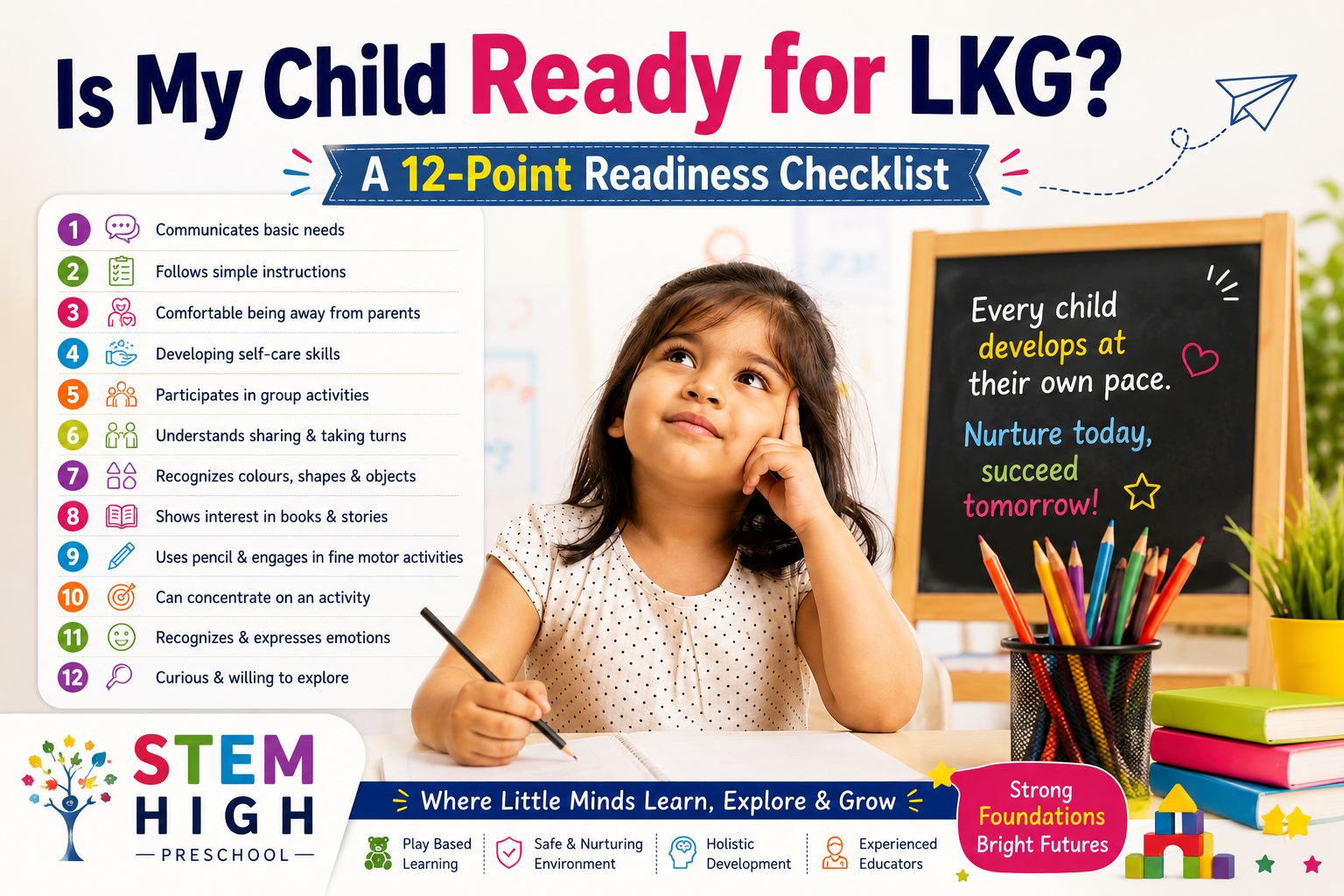
Starting LKG (Lower Kindergarten) is an exciting milestone for both children and parents. It is often the first structured step into formal schooling, and naturally, parents wonder: “Is my child really ready for LKG?”
The good news is that LKG readiness is not about knowing everything before school starts. A child does not need to read fluently, write perfectly, or memorize numbers to be ready. What matters more is whether they have developed basic social, emotional, communication, physical, and early learning skills that help them adjust to a classroom environment.
If you are considering LKG admission for your child, this 12-point readiness checklist can help you understand where your child is today and what areas you can gently work on at home.
LKG readiness means that a child is gradually developing the skills needed to participate in a school environment. These include being able to communicate their needs, interact with other children, follow simple instructions, manage basic self-care, concentrate on activities, and show curiosity about learning.
Every child develops at a different pace. So, this checklist should be used as a guide rather than a test.
At STEM High Preschool, children are encouraged to develop these foundational skills through play, exploration, hands-on activities, communication, and age-appropriate learning experiences rather than through pressure or rote memorization.
One of the most important LKG readiness skills is communication.
Your child should be able to express simple needs and feelings, such as:
They don’t need to speak perfect sentences or have an extensive vocabulary. The important thing is that they can communicate sufficiently with teachers and adults.
How parents can help:
Talk to your child throughout the day. Ask open-ended questions such as, “What did you do today?” or “What do you see outside?” Encourage them to describe their experiences instead of simply answering yes or no.
Classrooms involve instructions throughout the day. Your child should gradually become comfortable listening to and following simple directions.
For example:
Start with one-step instructions and gradually introduce two-step instructions.
For example:
“Take your shoes and keep them near the door.”
This develops listening, memory, and comprehension skills that are useful when your child starts LKG.
Separation anxiety is completely normal, particularly when children are entering preschool for the first time.
However, a child preparing for LKG should gradually become comfortable staying with trusted adults without their parents being present all the time.
You can prepare your child by:
At STEM High Preschool, creating a warm and welcoming environment can help children gradually become comfortable with teachers, classmates, and their new surroundings.
Children entering LKG are encouraged to become increasingly independent.
They don’t need to do everything perfectly, but they should be developing basic self-care abilities such as:
Parents can encourage independence by giving children enough time to complete small tasks themselves.
Instead of immediately doing something for your child, try asking:
“Would you like to try it yourself first?”
This builds confidence as well as independence.
LKG is not only about individual learning. Children spend a significant amount of time participating in group activities.
Your child should gradually learn to:
Don’t worry if your child is shy initially. Social confidence develops gradually through positive experiences.
Playdates, group activities, storytelling sessions, and outdoor play can all help.
Sharing and turn-taking are important social skills for preschool and LKG.
Children may naturally find sharing difficult at first. This is part of normal development. Parents can gently introduce the concept through games and everyday situations.
For example:
“You can play with the car for five minutes, then your friend gets a turn.”
Board games, building blocks, pretend play, and group activities can help children understand cooperation and patience.
The goal isn’t to force children to share everything. It is to gradually teach them that other people have needs, preferences, and turns too.
Academic knowledge isn’t the most important part of LKG readiness, but basic awareness is useful.
Your child may already be able to identify:
You don’t need to turn this into a formal lesson.
Try asking questions while playing:
“Can you find the red block?”
“Which one is bigger?”
“What shape is this?”
Learning through everyday experiences makes concepts easier and more enjoyable.
A child doesn’t need to read independently before entering LKG.
Instead, look for an interest in books, pictures, stories, and language.
Your child may:
These are excellent early literacy indicators.
Make reading part of your daily routine. Even 10–15 minutes of shared reading can help develop vocabulary, listening skills, imagination, and attention.
Fine motor development is another important area of LKG readiness.
Your child should have opportunities to practice activities such as:
Don’t focus too much on perfect handwriting at this stage.
Before children can write confidently, they need to develop the smaller muscles in their hands and fingers. Play-based fine motor activities are a natural way to build these skills.
Young children naturally have short attention spans. They aren’t expected to sit quietly for long periods like older students.
However, your child should gradually be able to stay engaged with an interesting activity for a reasonable amount of time.
For example, they may be able to:
You can strengthen attention by reducing unnecessary screen distractions and providing opportunities for uninterrupted play.
Remember: quality of attention matters more than forcing a child to sit still.
Emotional readiness is sometimes overlooked when parents think about school preparation.
Your child should gradually learn to identify and communicate feelings such as:
They don’t need to control every emotion. Emotional regulation develops over time.
Instead of saying:
“Don’t cry.”
Try:
“I can see that you’re upset. Tell me what happened.”
Helping children name their emotions gives them tools to communicate instead of relying only on crying, shouting, or withdrawing.
Perhaps the most valuable LKG readiness sign is curiosity.
Does your child ask questions?
Do they want to know how things work?
Do they enjoy exploring?
Do they experiment with objects?
Do they ask “Why?” and “How?”
Do they enjoy discovering something new?
If the answer is yes, your child already has one of the most important foundations for learning.
A good early childhood environment should nurture this curiosity rather than discourage it.
This is one reason approaches that combine play, exploration, creativity, and hands-on learning can be valuable during the preschool years. At STEM High Preschool, children are encouraged to explore concepts through age-appropriate activities that help make learning engaging and meaningful.
Quick LKG Readiness Checklist
Parents can use the following checklist as a simple self-assessment:
Don’t panic.
LKG readiness is not an all-or-nothing test.
Children develop at different rates, and strengths can vary considerably. One child may have excellent language skills but need more support with self-care. Another may be very independent but shy in group situations.
Instead of asking:
“Is my child perfect for LKG?”
Ask:
“Is my child developing the skills needed to learn, communicate, participate, and become more independent?”
If there are areas where your child needs support, you can work on them gradually through everyday activities.
You don’t need expensive educational materials or long study sessions.
Simple routines can make a big difference.
Try to maintain consistent timings for:
A predictable routine helps children understand what comes next and can make the transition to school easier.
Let your child try simple tasks independently.
For example:
“Can you put your shoes away?”
“Can you pack your water bottle?”
“Can you clean up your toys?”
Even if the task takes longer, allowing your child to try builds confidence.
Learning at this age doesn’t have to look like studying.
Count toys.
Sort blocks by colour.
Identify shapes around the house.
Read stories.
Sing songs.
Build towers.
Draw pictures.
Play memory games.
Ask questions while going for a walk.
These simple experiences can support early cognitive and language development.
Knowing some letters, numbers, colours, or shapes can certainly be helpful, but it should not be the only measure of school readiness.
A child who knows the alphabet but cannot communicate their needs, participate in a group, or manage basic routines may still need support with other readiness skills.
Early education should focus on the whole child—social, emotional, physical, language, cognitive, and creative development.
The transition into LKG becomes easier when children have already experienced a supportive preschool environment.
A good preschool can help children gradually develop:
At STEM High Preschool, the focus can naturally extend beyond worksheets and memorization by giving children opportunities to learn through exploration, play, activities, and real-world experiences.
This approach can help children develop the confidence and foundational skills they need as they move toward LKG and eventually into formal schooling
Preparing for LKG isn’t about making your child academically advanced. It is about helping them become confident, curious, communicative, independent, and comfortable learning with others.
If your child can communicate basic needs, follow simple instructions, participate in activities, interact with others, attempt self-care, and show curiosity about the world, they are developing many of the foundations needed for a positive LKG experience.
And remember—readiness is a journey, not a competition.
Give your child opportunities to play, explore, talk, create, make mistakes, and try again. With the right support at home and a nurturing preschool environment such as STEM High Preschool, children can gradually build the skills and confidence they need for their next exciting stage of learning.
Need help? Our team is just a message away








Comments are closed