Monday to Friday: 09:00am – 07:00pm
Sunday: Close
Email:stemhighpreschool@gmail.com
Phone:+91 8050125666
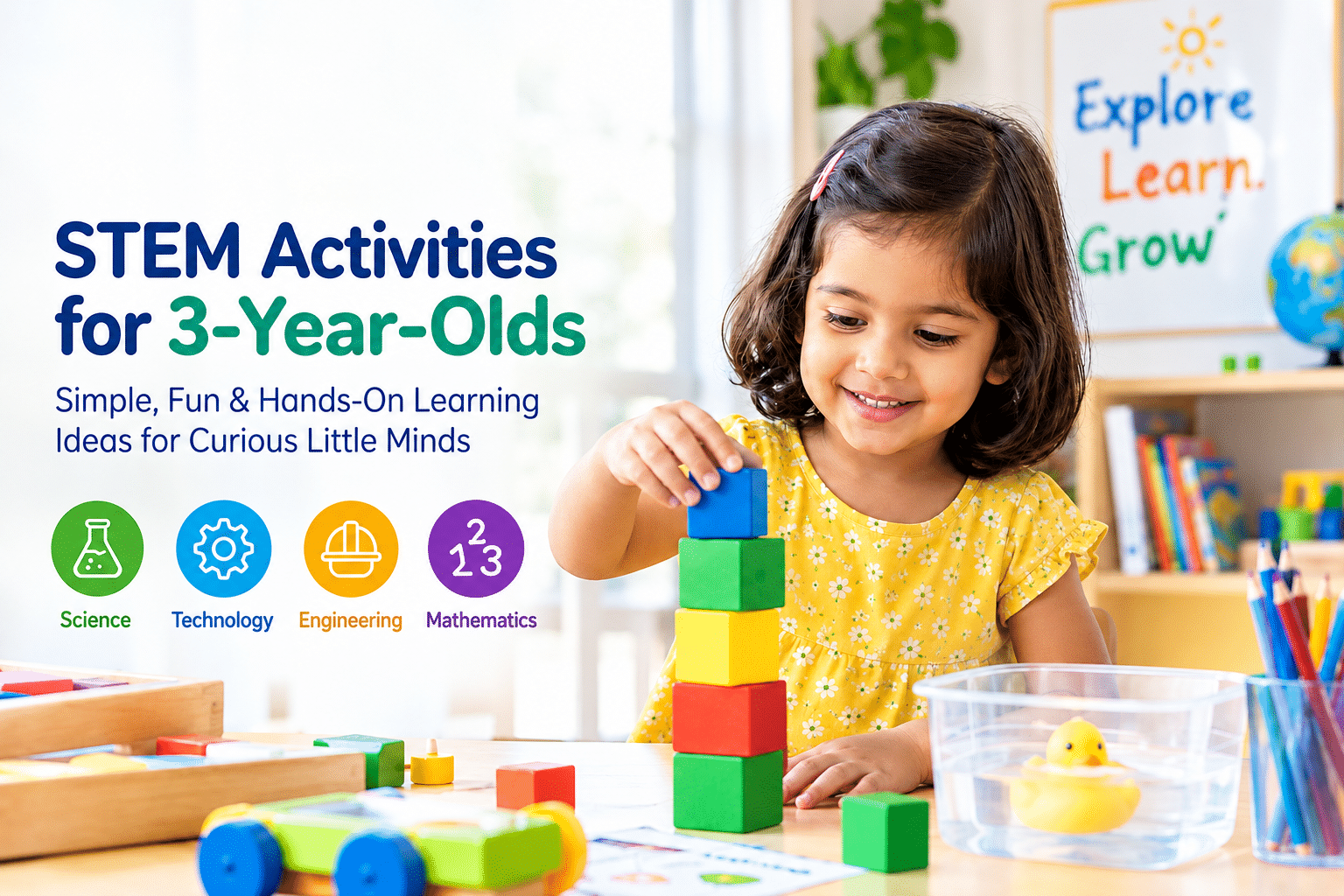
Children are naturally curious about the world around them. At the age of three, they love touching objects, building towers, asking questions, exploring colours, playing with water, and discovering what happens when they try something new. These everyday experiences can become exciting learning opportunities through STEM activities.
STEM activities for 3-year-olds introduce young children to Science, Technology, Engineering, and Mathematics through simple, playful, hands-on experiences. They do not require expensive equipment, complicated experiments, or advanced academic knowledge. Everyday household objects, toys, blocks, water, and natural materials can provide excellent opportunities for exploration.
For parents looking for ways to support early learning at home, STEM activities offer an enjoyable way to encourage curiosity, creativity, logical thinking, and problem-solving.
In this guide, we explore 15 easy STEM activities for 3-year-olds, their developmental benefits, and practical ways to introduce STEM learning into your child’s daily routine.
STEM stands for:
For three-year-old children, STEM education should be playful, age-appropriate, and guided by curiosity rather than formal lessons.
For example, when a child builds a tower with blocks, they are exploring balance and engineering. When they sort toys by colour, they are developing early mathematical thinking. When they observe a plant growing, they are beginning to understand science.
These experiences help children discover how things work while developing important foundational skills.
Early childhood is an important period for developing thinking skills, language, movement, and social interaction. Simple STEM activities can support these areas by giving children opportunities to explore and experiment.
Young children often ask questions such as “Why?”, “What is this?” and “What happens next?”
STEM activities encourage them to investigate their surroundings and discover answers through observation.
When a tower falls or a toy bridge cannot support an object, children can try a different approach. These small challenges encourage them to explore solutions.
Sorting, counting, comparing sizes, identifying shapes, and recognising patterns help children become familiar with mathematical concepts.
Describing what they see helps children develop vocabulary. Words such as heavy, light, tall, short, wet, dry, full, empty, fast, and slow can be introduced naturally during play.
Picking up blocks, transferring water with a large scoop, placing objects into containers, and arranging toys help children practise hand-eye coordination and controlled movements.
STEM activities often have several possible solutions. Children can build different structures, create patterns, and experiment with materials in their own ways.
When something does not work the first time, children can try again with encouragement. This helps them become more comfortable with challenges and new experiences.
The following activities use simple materials and focus on exploration rather than achieving a perfect result. Adult supervision is essential, especially during activities involving water, small objects, or household materials.
<em>STEM focus: Engineering, mathematics, and problem-solving</em>
Building towers is one of the simplest STEM activities for preschoolers.
Materials needed:
How to do it:
What children learn:
Children begin exploring height, balance, shapes, stability, and cause and effect.
Ask questions such as, “How can we make the tower taller?” or “What happens if we put a bigger block at the bottom?”
Allow your child to experiment rather than building the tower for them.
<em>STEM focus: Science and observation</em>
Children often enjoy discovering why some objects float while others sink.
Materials needed:
Choose objects that are too large to swallow and safe for water play.
How to do it:
What children learn:
Children practise making predictions, observing results, comparing objects, and using descriptive language.
At this age, the goal is simply to notice differences, not to memorise scientific explanations.
Safety tip: Supervise children continuously and remain within arm’s reach around water, even when the water is shallow.
<em>STEM focus: Mathematics and logical thinking</em>
Sorting activities help children recognise similarities and differences.
Materials needed:
How to do it:
What children learn:
This activity introduces colour recognition, grouping, classification, counting, and comparison.
As your child becomes comfortable, try sorting by shape or type of object.
<em>STEM focus: Physics and engineering</em>
A ramp lets children explore how objects move.
Materials needed:
How to do it:
What children learn:
Children begin exploring movement, speed, slopes, and cause and effect.
Ask, “What happens when we raise the ramp?” and let your child observe the result.
Use a stable setup and keep the activity away from stairs or elevated surfaces.
<em>STEM focus: Science, mathematics, and fine motor development</em>
Water transfer is a simple sensory activity that introduces children to volume and measurement.
Materials needed:
How to do it:
What children learn:
Children practise hand-eye coordination, comparison, measurement language, and observation.
Safety tip: Use only a small amount of water and supervise continuously.
<em>STEM focus: Mathematics, engineering, and creativity</em>
Playdough provides a fun way to explore shapes and structures.
Materials needed:
How to do it:
What children learn:
This activity supports creativity, shape recognition, spatial awareness, and fine motor skills.
Choose materials appropriate for your child’s age and supervise closely to prevent mouthing or swallowing.
<em>STEM focus: Science and mathematics</em>
Nature provides many opportunities to observe shapes, textures, colours, and patterns.
Materials needed:
How to do it:
What children learn:
Children practise observation, classification, counting, and awareness of the natural world.
Avoid collecting unknown plants, mushrooms, sharp objects, or anything that may be unsafe to touch.
<em>STEM focus: Engineering and problem-solving</em>
Children can explore how simple structures support objects.
Materials needed:
How to do it:
What children learn:
Children begin exploring support, balance, structure, and design.
Encourage experimentation instead of expecting the child to build a perfect bridge.
<em>STEM focus: Early mathematics</em>
Counting everyday objects makes mathematics meaningful.
Materials needed:
How to do it:
What children learn:
Children become familiar with number words, quantity, grouping, and simple comparisons.
Use a small number of objects at first and increase the challenge gradually.
<em>STEM focus: Science and nature</em>
Growing a plant gives children an opportunity to observe change over time.
Materials needed:
How to do it:
What children learn:
Children begin understanding living things, growth, observation, and responsibility.
Avoid plants that may be toxic or irritating, and do not allow children to eat soil or plant material.
<em>STEM focus: Mathematics and logical thinking</em>
Patterns help children recognise order and repetition.
Materials needed:
How to do it:
What children learn:
Children begin recognising repetition, sequences, colours, and early mathematical relationships.
Keep patterns simple at first and offer help when needed.
<em>STEM focus: Science and observation</em>
Shadows can make an ordinary day feel like a science adventure.
Materials needed:
How to do it:
What children learn:
Children practise observation and begin exploring light, shapes, and changes in their environment.
Never encourage children to look directly at the sun.
<em>STEM focus: Mathematics and classification</em>
Comparing sizes helps children develop early mathematical language.
Materials needed:
How to do it:
What children learn:
Children develop comparison skills and become familiar with concepts such as bigger, smaller, taller, and shorter.
<em>STEM focus: Science and listening</em>
Sound exploration helps children notice how different objects produce different sounds.
Materials needed:
How to do it:
What children learn:
Children practise listening, comparison, observation, and descriptive language.
Avoid glass objects, sharp utensils, loud noises, and anything that could break or cause injury.
<em>STEM focus: Engineering, spatial awareness, and movement</em>
A simple obstacle course combines movement with opportunities to follow instructions and solve problems.
Materials needed:
How to do it:
What children learn:
Children practise spatial awareness, movement, sequencing, and problem-solving.
Keep obstacles low and stable, avoid climbing on furniture, and supervise the activity.
The goal of preschool STEM is not to teach children complicated concepts. It is to create opportunities for discovery.
If your child enjoys cars, explore ramps and movement. If they enjoy plants, observe leaves and growth. When an activity connects with a child’s interests, participation often becomes more enjoyable.
Instead of immediately explaining everything, ask simple questions such as:
Give your child time to respond, point, gesture, or demonstrate an idea.
A tower falling or a structure bending can be part of the learning experience. Help your child try again rather than correcting every result.
Three-year-olds usually benefit from brief activities that match their attention and interests. Some activities may last only a few minutes, while others may continue longer if the child remains engaged.
There is no need to complete an activity if your child loses interest.
You do not need expensive STEM kits. Large blocks, cups, cardboard, playdough, toys, plants, and safe household objects can support meaningful learning.
Praise your child’s effort, curiosity, and willingness to try.
For example, say, “You tried a different way to build the tower,” rather than focusing only on whether the tower stayed standing.
Parents and educators can introduce one simple activity each day without turning play into a formal lesson.
Day | Activity | Main Learning Focus |
Monday | Build a block tower | Engineering and balance |
Tuesday | Sink or float | Science and observation |
Wednesday | Sort toys by colour | Mathematics and grouping |
Thursday | Explore a ball ramp | Movement and cause and effect |
Friday | Nature shape hunt | Observation and classification |
Saturday | Playdough shapes | Creativity and fine motor skills |
Sunday | Water transfer with adult supervision | Comparison and measurement language |
Repeat favourite activities whenever your child enjoys them. Repetition can help children become more familiar with concepts and build confidence.
STEM activities can support several areas of early childhood development.
Skill | Example of STEM Learning |
Problem-solving | Finding a way to make a tower stand |
Early mathematics | Counting blocks and comparing sizes |
Scientific thinking | Observing whether objects float |
Creativity | Building different structures |
Language | Describing what happened |
Fine motor skills | Handling blocks and playdough |
Spatial awareness | Exploring ramps and obstacle courses |
Persistence | Trying a new approach after a structure falls |
Observation | Noticing changes in a growing plant |
Independence | Choosing materials and trying simple tasks |
Children develop at different rates, so these activities should be adapted to their interests and abilities.
Many STEM activities can be adapted for children with different interests, abilities, and developmental needs.
Some children may enjoy building and construction, while others prefer water play, nature, music, or sorting games.
Parents and teachers can adapt activities by:
The focus should be on participation, exploration, and enjoyment rather than comparing children.
Home activities are a useful way to encourage curiosity, but a preschool environment can provide additional opportunities for children to explore with teachers and peers.
A quality early learning environment may include building materials, puzzles, creative resources, age-appropriate science activities, storytelling, outdoor exploration, and guided group activities.
Teachers can introduce questions, demonstrate safe use of materials, and encourage children to share observations and ideas.
For parents searching for a STEM preschool in Ramamurthy Nagar, Bangalore, it is helpful to ask how the school integrates hands-on STEM learning into its daily routine and how activities are adapted for younger children.
At STEM High Preschool in Ramamurthy Nagar, Bangalore, parents can explore an early learning environment that highlights STEM education and activity-based learning.
When evaluating a preschool for a three-year-old, consider whether its learning approach gives children opportunities to ask questions, explore materials, build, create, observe, communicate, and solve simple problems.
Parents can also ask about age-appropriate activities, teacher supervision, classroom safety, outdoor play, and how educators support children’s individual development.
The aim of early STEM learning is not to make three-year-olds master science or mathematics. It is to nurture curiosity and provide a positive foundation for future learning.
Safety is essential when planning activities for young children.
Keep these guidelines in mind:
At three years old, children may still explore objects with their mouths. Choose materials carefully and remain actively involved.
Simple activities such as building block towers, sorting toys by colour, exploring sink-or-float objects, making playdough shapes, observing plants, and rolling balls down ramps are good starting points.
Start with your child’s interests and everyday objects. Ask simple questions, encourage exploration, and allow your child to discover what happens. You do not need specialised equipment or formal lessons.
STEM activities can support skills associated with preschool learning, including observation, communication, early mathematics, fine motor development, curiosity, and problem-solving. They are one part of a broader early childhood learning experience.
There is no fixed duration. Keep activities short and follow your child’s attention and interest. Stop or change the activity when the child becomes tired or loses interest.
No. Many useful STEM experiences can be created with large blocks, cups, cardboard, playdough, plants, and everyday objects. Age-appropriate toys can be helpful, but they are not essential.
STEM play intentionally encourages children to explore ideas related to science, technology, engineering, and mathematics. It can still be enjoyable and open-ended, with children learning through ordinary play rather than formal instruction.
Yes. Many excellent STEM activities are hands-on and screen-free, including building, sorting, water play, nature exploration, and simple construction challenges.
The best STEM activities for 3-year-olds are simple, safe, playful, and suited to a child’s interests.
Building towers, sorting objects, exploring water, observing plants, making patterns, and experimenting with ramps can introduce early scientific and mathematical thinking while supporting creativity, communication, and problem-solving.
Parents do not need to turn every activity into a lesson. Sometimes the most valuable learning happens when a child asks a question, tries something new, observes the result, and decides to try again.
By making room for exploration at home and choosing a supportive early learning environment, parents can help children develop a lasting interest in discovery.
If you are looking for a STEM preschool in Ramamurthy Nagar, Bangalore, explore STEM High Preschool and ask how its early learning programs support curiosity, creativity, hands-on exploration, and whole-child development.
Need help? Our team is just a message away






Comments are closed