
Monday to Friday: 09:00am – 07:00pm
Sunday: Close
Email:stemhighpreschool@gmail.com
Phone:+91 8050125666
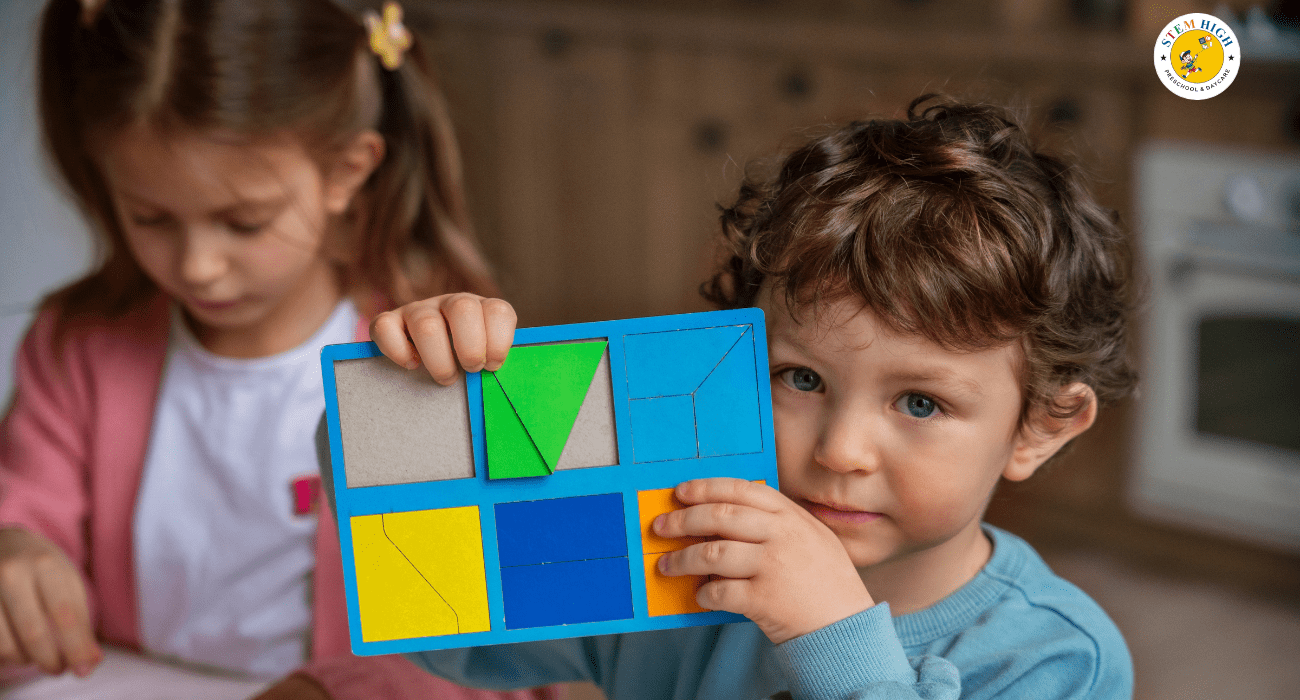
When parents think about preschool, they often focus on learning alphabets, numbers, and social skills. While these are important, one of the most powerful abilities children develop during early childhood is problem-solving skills.
Problem-solving is not something that suddenly appears in primary school. It begins much earlier—during the preschool years—when children start exploring, questioning, experimenting, and learning through everyday experiences.
In this blog, we will explore why problem-solving skills start in preschool, how they develop naturally, and why early childhood education plays a critical role in shaping confident, independent thinkers.
Problem-solving skills refer to a child’s ability to:
For preschoolers, problems may seem simple to adults, such as:
But these small daily challenges are the building blocks of critical thinking.
The preschool years (ages 2–6) are a time of rapid brain development. During this stage:
Young children are naturally curious. They constantly ask “why?” and “how?” This curiosity is the foundation of problem-solving.
A well-structured preschool environment channels that curiosity into meaningful learning experiences.
Play is not just entertainment—it is how children think.
During play, preschoolers:
For example:
When a child builds with blocks and the structure falls, they learn:
Without formal instruction, they are learning engineering concepts.
At STEM High Preschool, play-based learning is intentionally designed to promote thinking. Children are encouraged to explore materials, experiment freely, and find solutions independently.
Puzzles teach:
Construction toys like blocks or magnetic tiles help children:
These activities strengthen persistence and resilience.
Dramatic play encourages children to:
For example, if two children want to be the “teacher” in a pretend classroom, they must negotiate or find a compromise. This builds both social and cognitive problem-solving.
Outdoor learning presents real-world challenges:
Nature-based experiences stimulate critical thinking and cooperation.
When children work in groups, they encounter differences in ideas.
They must learn to:
These are essential life skills that begin in preschool classrooms.
Problem-solving is not only about logic—it is also about emotions.
When a child’s block tower falls, they may feel frustrated. Learning to manage that frustration is part of solving the problem.
Preschool helps children:
At STEM High Preschool, teachers guide children gently through challenges rather than immediately fixing problems for them. This approach builds emotional resilience.
Teachers play a crucial role in nurturing thinking skills.
Instead of giving direct answers, effective educators ask open-ended questions like:
This questioning approach encourages children to think deeply rather than depend on adult solutions.
At STEM High Preschool, teachers act as facilitators—guiding children to explore ideas, test solutions, and reflect on outcomes.
When children are allowed to:
They develop independence.
Independence strengthens:
Problem-solving thrives when children feel capable.
The benefits of early problem-solving extend far beyond preschool.
Children who develop strong thinking skills early:
Problem-solving is the foundation for STEM learning, analytical thinking, and creative innovation.
The skills developed during preschool become the base for lifelong learning.
Parents can reinforce these skills through simple daily practices:
Give your child time to think and try.
Instead of giving answers, ask:
Provide open-ended toys like:
Mistakes are essential for learning. When children fail safely, they grow stronger thinkers.
Not all preschools emphasize thinking skills equally.
An effective preschool should:
At STEM High Preschool, the curriculum integrates structured guidance with creative exploration. Children are encouraged to question, experiment, and discover solutions independently. This balanced approach builds both academic readiness and real-world problem-solving skills.
Every time a child solves a problem, they experience:
Confidence fuels curiosity. Curious children become lifelong learners.
By nurturing problem-solving skills early, preschools help children feel capable—not just in academics, but in everyday life.
Problem-solving skills do not begin in primary school—they begin the moment a child starts exploring the world.
Preschool is where children:
Need help? Our team is just a message away







Comments are closed